


TP Turdinator® RV Black Tank Treatment
BUY 2+ & SAVE 10% — AUTOMATICALLY APPLIED
TP Turdinator® is an enzyme-powered RV and marine black tank treatment designed to help break down toilet paper and organic waste, reduce odor-causing buildup, support cleaner tank dumping, and help keep holding tanks performing their best. Developed by professional formulators and manufactured in the USA, TP Turdinator was created to solve the same black tank problems we experienced as RV owners.
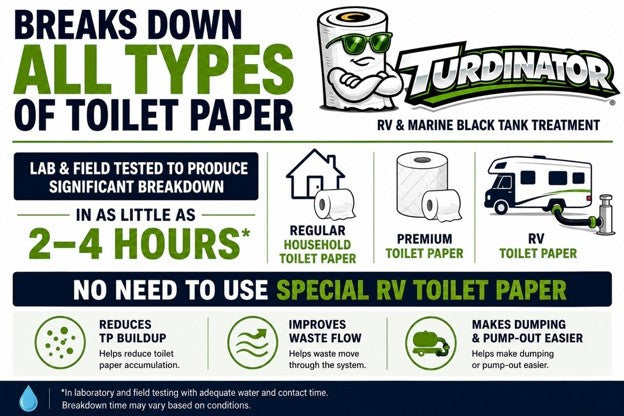
Breaks Down Toilet Paper
in as Little as 2–4 Hours
TP Turdinator® is an enzyme-powered RV black tank treatment and marine holding tank treatment designed to help break down toilet paper and organic waste in RVs, campers, boats, and marine sanitation systems.
In laboratory and field testing, TP Turdinator® produced significant breakdown of regular household toilet paper, premium toilet paper, and RV toilet paper in as little as 2–4 hours when used with adequate water, product, and contact time.
By helping break toilet paper into smaller particles, TP Turdinator® helps reduce toilet paper buildup, improve black tank waste flow, and make dumping or pump-out easier. This can be especially beneficial for boats, marine sanitation systems, and RVs equipped with macerator pumps, where waste must move efficiently through pumps, hoses, and plumbing.
TP Turdinator® works with regular household toilet paper, premium toilet paper, and RV toilet paper, so you do not need to buy special RV toilet paper for your black tank.
For best results: Use the recommended amount of TP Turdinator® with adequate water and allow sufficient contact time. Breakdown time may vary depending on water level, temperature, amount and type of toilet paper, tank conditions, and contact time.
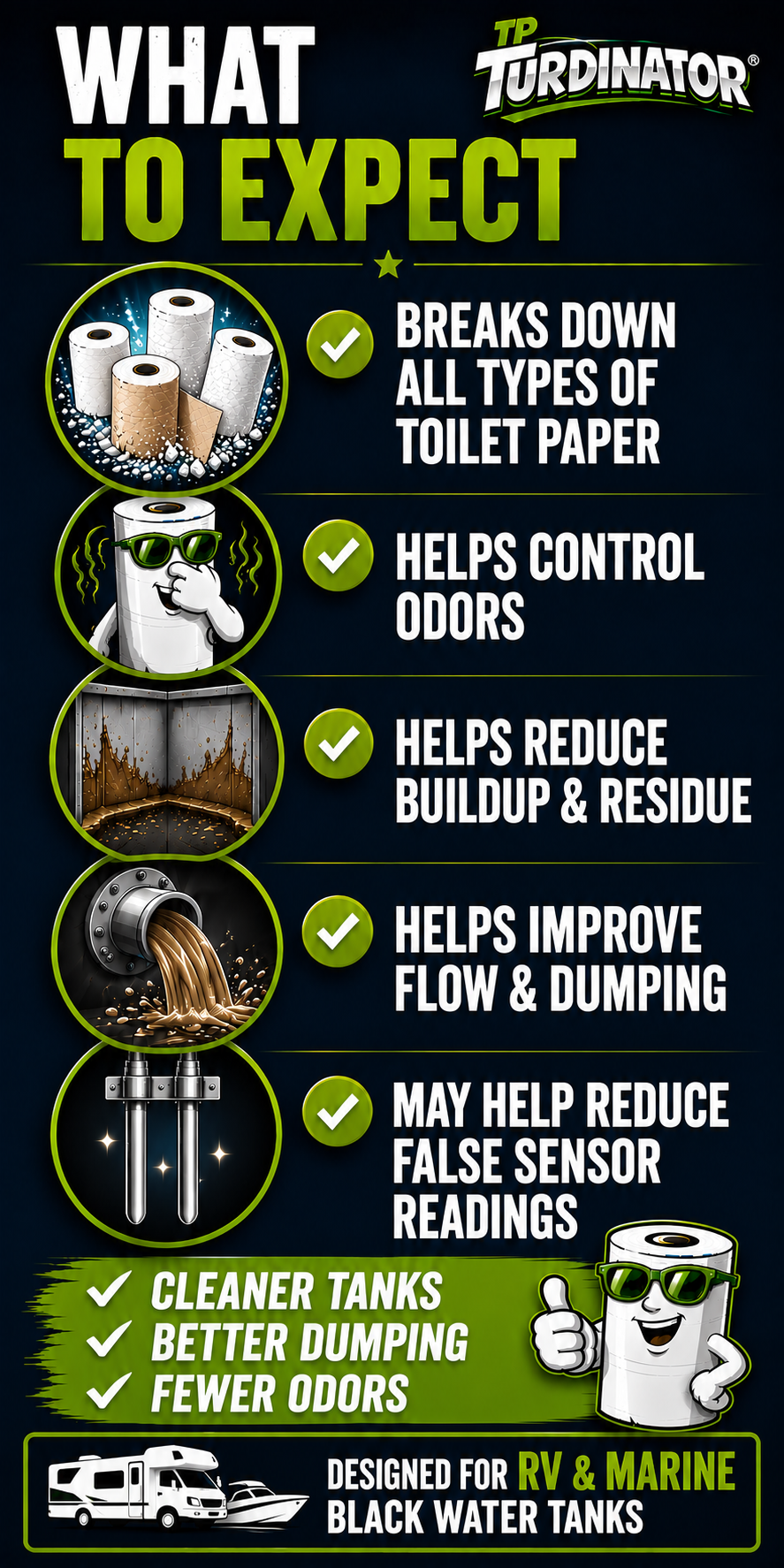
What To Expect
TP Turdinator® is a science-based, enzyme-powered black water holding tank treatment designed for RVs, campers, boats, and marine sanitation systems. Once added with water, the enzymes begin working when they come into contact with toilet paper and organic waste.
Toilet Paper Breakdown:
In our laboratory and field testing, TP Turdinator® produced significant toilet paper breakdown in as little as 2–4 hours when used with adequate water and contact time
Odor Control
Helps control odors by breaking down organic waste and residue that contribute to odor formation rather than simply masking odors with heavy fragrance
Waste Breakdown
Enzymes continue working on toilet paper and organic waste while adequate water and suitable conditions are present.
Easier Dumping & Pump-Out
Breaking toilet paper and organic waste intosmaller particles helps material move through the system and out of the tankduring dumping or pump-out.
Macerator Pump Systems
TP Turdinator® can be used in RV, Airstream, boat, and marine black water systems equipped with macerator pumps. By helping break down toilet paper and organic waste into smaller particles before pump-out, TP Turdinator® helps reduce the amount of larger solid material that must pass through the macerator pump and discharge hose.
Buildup & Tank Sensors
Continued use can help reduce organic residue andbuildup on tank surfaces and sensor probes that may contribute to falsereadings
Adjust Treatment to Tank Conditions
Holding tanks are dynamic systems. Aswaste load, water level, temperature, holding time, and buildup change,treatment needs can change too. For heavier use, stronger odors, or difficult tankconditions, increase TP Turdinator® and/or water as needed.
For Best Results
Start with adequate water and the recommended dose, keep theblack tank valve closed during normal use, and give the enzymes time to work beforedumping or pump-out. Adjust the amount of TP Turdinator® and water based onwaste load, tank conditions, and usage.
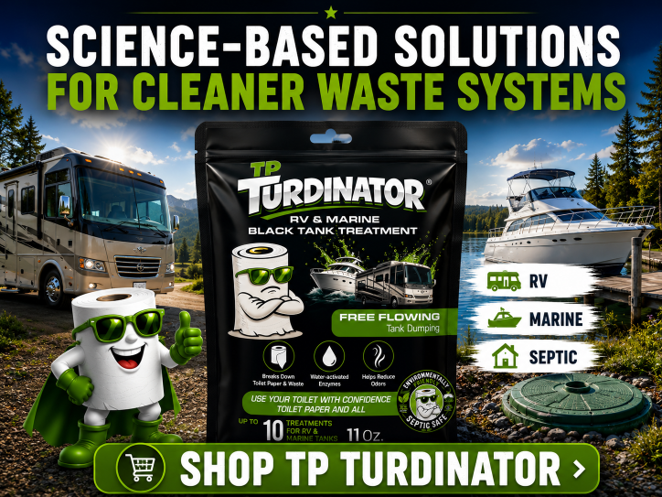
WHY TP TURDINATOR?
SCIENCE-BASED SOLUTIONS FOR
CLEANER WASTE SYSTEMS
TP Turdinator is designed to help break down waste and toilet paper, helping control holding tank odors by breaking down the organic waste that contributes to odor formation, and supporting smoother overall system performance.
At Turdinator, we focus on solving real waste system problems through research, testing, and practical product development.
We believe effective products should address the source of a problem, not simply cover it up.
Our formulations are developed to support toilet paper breakdown, waste digestion, odor control, and cleaner system operation.
Every product is created with the same commitment to performance, safety, and continuous improvement.
Whether you use an RV, boat, or septic system, our goal is to help you achieve cleaner, more reliable waste system performance.
Better performance. Fewer headaches. More time enjoying what matters most.
How TP Turdinator Works
The enzyme, chelating agent, and surfactant system behind cleaner tanks.
TP Turdinator® is a science-backed RV and marine black tank treatment formulated to help break down toilet paper and waste, reduce buildup, and support cleaner, better-performing holding tanks. Designed to break down waste and toilet paper, support cleaner tank dumping, and help reduce unwanted odors, TP Turdinator works by addressing the source of the problem rather than simply masking it with fragrance or dyes.
As full-time formulators, we spent over three years developing TP Turdinator® in our laboratory and in real RV and marine field testing before finalizing the formula. Every ingredient was selected based on enzyme science, wastewater treatment principles, published literature, and internal testing, not marketing trends.
Instead of relying on perfume and dye, TP Turdinator® uses a coordinated system of:
- Enzymes to help break down toilet paper and organic waste
- A chelating agent to help loosen mineral-supported deposits
- Surfactants to help lift and suspend loosened waste so it actually leaves the tank during dumping
Septic systems and treatment plants are designed to break waste down: waste stays for days or weeks, conditions are relatively stable, and there is active mixing and engineered biology.
RV and marine holding tanks are short-term storage: waste is only in the tank for hours or a few days, water level, pH, and temperature constantly change, and there is very little mixing inside the tank.
That means natural processes don't have enough time to fully break down toilet paper and waste before you dump.
Because holding tanks can't do septic-style work:
- Toilet paper and waste often stay in larger pieces.
- Thin layers of residue build up after every trip.
- Over time, this causes pyramid plugs, odors, and dirty sensors.
TP Turdinator® is formulated specifically for RV and marine tanks to:
- Help break down toilet paper and waste faster.
- Help loosen mineral-supported deposits on walls and probes.
- Help keep loosened material suspended so it can leave the tank when you dump.
Combined with good habits (starting with water, using plenty each flush, keeping the valve closed), this gives your black tank the help a septic system gets naturally—but in the much shorter time your RV or boat actually has.
Our internal lab testing showed water alone rarely produced the level of toilet paper breakup RV and marine owners expect within normal tank retention times, while water plus TP Turdinator® significantly improved softening and breakup—especially when water volume and contact time were adequate.
Enzymes are biological catalysts. That means:
- They are proteins that speed up natural chemical reactions.
- They help break specific types of molecules into smaller pieces.
- They are not used up in each reaction—so the same enzyme can work again and again.
In simple terms, enzymes act like tiny molecular scissors: an enzyme attaches to a specific material (such as cellulose, protein, fat, or starch), cleaves (cuts) a larger molecule into smaller pieces, lets go and moves on to another molecule, and repeats over and over, often thousands or millions of times.
Because enzymes are catalysts, they can keep working for hours—and often days in RV and marine holding tanks, as long as there is water, temperatures are reasonable, and toilet paper and waste are still present.
Published research on hydrolytic enzymes shows that enzyme activity in systems like wastewater treatment, composting, and biomass conversion typically occurs over extended periods—not just minutes.
In nature, wastewater treatment plants, and compost systems, multiple enzymes work together because different materials require different tools. TP Turdinator® follows the same principle: cellulase targets toilet paper (cellulose), protease targets proteins in fecal matter and organic waste, lipase targets fats and oils, and amylase targets starches and carbohydrates.
Each enzyme is like a different set of scissors. Together, they help break down the full spectrum of materials found in RV and marine black tanks, support better toilet paper breakup, improve waste movement, contribute to cleaner tank walls and more reliable sensors, and reduce material that can fuel odors between trips.
We did not pick enzymes just because they "sound good" on a label. Each was chosen for a specific, scientifically supported role in RV and marine holding tank conditions.
Once enzymes and chelating agents have loosened residues, you still have to get that material out of the tank. If it simply resettles on the bottom or sticks to the walls, the problem returns. That's where surfactants come in.
Surfactants are cleaning ingredients that help water spread out, wet surfaces, and lift loosened waste so it can be carried out of your RV or marine holding tank when you dump. Untreated water tends to bead up and avoid certain surfaces; with surfactants, water spreads into a thin, uniform film and can reach more of the tank interior.
Surfactants are extensively used in household and industrial cleaners, detergents and rinsing aids, and wastewater and environmental cleaning applications.
Inside RV and marine tanks, surfactants improve wetting of tank walls, plumbing, and sensor surfaces, help lift loosened residues off those surfaces, help keep toilet paper fibers and waste suspended in the water instead of settling back down, and improve movement of treated material toward the dump valve or pump-out point.
By helping suspend loosened material in the water column, surfactants increase the chance that it actually leaves the tank during dumping instead of becoming tomorrow's buildup.
How to Use TP Turdinator
Best practices for consistent, reliable results.
For best performance: start with several inches of water in the tank after dumping, use adequate water with every flush, keep the black tank valve closed during normal use, and whenever practical, allow 2–4 hours or longer of contact time after adding TP Turdinator® before dumping or pumping out.
Every flush introduces new toilet paper and waste, so regular dosing during extended trips helps ensure fresh enzyme activity is available for newly added material, rather than relying only on enzymes added days earlier.
TP Turdinator® is grounded in published enzyme, chelation, and surfactant science plus wastewater and cleaning chemistry. It is laboratory-tested, evaluated under simulated RV and marine holding tank conditions using real toilet papers, competing treatments, and realistic water and contact-time scenarios. And it is field-tested, refined over more than three years of full-time formulation work and real-world RV and marine use.
For RV and marine owners, that translates into a treatment intentionally formulated to help break down toilet paper and organic waste, help loosen mineral-supported deposits and scale, help carry loosened material out of the tank, support cleaner tank walls, and help control odor by reducing the waste and residue that contribute to it.
Frequently Asked Questions

For best results, use TP Turdinator regularly according to the dosing instructions on the label. Consistent use helps reduce buildup, control odors, and support cleaner tank dumping.
Yes. When used as directed, TP Turdinator is septic safe and formulated without harsh chemicals.
Waste and toilet paper that accumulate on tank walls and sensors are a common cause of inaccurate tank readings. When used regularly, with adequate water and according to the directions, TP Turdinator is designed to help break down this buildup over time, which may help improve tank sensor performance. Results will vary depending on the condition of the tank and sensors.
Yes. TP Turdinator has been tested with RV toilet paper and regular household toilet paper, including premium and quilted varieties.
When used correctly with adequate water, TP Turdinator helps break down toilet paper so it can disperse more readily in the holding tank and discharge more easily when dumping.
Different toilet papers break down at different rates, so adequate water, proper dosage and sufficient contact time are important for best results
Yes. When used as directed, with adequate water and sufficient contact time, TP Turdinator is designed to help break down the organic waste that contributes to holding tank odors. Most users should experience improved odor control as the biological waste in the tank is reduced.
Yes. TP Turdinator is designed for use in RV, camper, trailer, and marine holding tanks when used according to the directions.
Yes. We recommend adding TP Turdinator® to your gray water tanks periodically to help keep the entire waste system working properly.
Gray tanks collect soap residue, body oils, grease, food particles and other organic material from sinks and showers. Over time, this material can contribute to buildup, biofilm and unpleasant odors.
Add ½ scoop of TP Turdinator® to each gray water tank with plenty of water. For best results, allow the treatment time to work before dumping.
Regular treatment of both your black and gray water tanks can help control odors, reduce organic buildup and keep waste flowing and dumping more easily.
Still Have Questions?
We're here to help you keep your tanks clean and your adventures worry-free.
Visit Our Support Center
Step-by-step guides, troubleshooting, and video tutorials.
Contact Our Team
Can't find what you need?
We're happy to help!

MADE IN THE USA
Created by RV Owners. Developed by Professional Formulators.
We’re Bill and Jack Soukup, a father-and-son team of full-time professional product formulators and RV owners with decades of experience developing enzyme-based specialty chemical products. We developed TP Turdinator because we wanted a black tank treatment that actually worked—not one that simply masked odors.
Bill & Jack Soukup
Founders, TP Turdinator
Made in the USA
Researched, developed, tested, and manufactured by us in the USA.
TECHNICAL INFORMATION
Educational Resources
In-depth information on how TP Turdinator is formulated and tested.
Using TP Turdinator for Black-Tank Odor
Managing gas, pyramids, and water level.
Black tank odors come from gases produced as waste breaks down—things like hydrogen sulfide, ammonia, and volatile fatty acids. These gases are generated inside the tank and will rise up wherever they find a path.
Two key points: odor is a symptom; trapped waste and residue are the underlying cause. And the water level in the tank matters for odor.
If you have a pyramid plug or a mound of waste and toilet paper building up, and the water level does not cover that pile, odor gases can rise directly from the exposed waste into the RV or boat, and even the best treatment will struggle because vapors bypass the water barrier and treatment solution.
For effective odor control in RV and marine black tanks: always maintain enough water so that the highest waste "pyramid" is submerged. This submerged waste is then in contact with enzymes, chelating agents, surfactants, and water, allowing the chemistry to work and gases to dissolve and vent properly instead of rising straight up.
TP Turdinator® does not rely on heavy perfume to hide odors. Instead, it focuses on helping break down toilet paper and organic waste into smaller particles (enzymes), helping loosen mineral-supported deposits that trap old residue (chelating agent), and helping lift and suspend loosened material so it exits during dumping (surfactants).
Our lab testing indicated that the amount of residual waste and toilet paper left after dumping is one of the biggest drivers of ongoing odor problems. By improving breakup and removal, TP Turdinator® reduces the material available to keep generating odor between trips.
Combined with correct water level (over the pyramid) and proper venting, this source-focused approach is more effective and more sustainable than just adding stronger fragrances.
Breaking Down Toilet Paper and Waste
Cellulase, protease, lipase, and amylase — four enzymes, four jobs.
Cellulase is one of the most important enzymes in TP Turdinator® because toilet paper is made primarily of cellulose. In industry, cellulases are widely used in:
- Pulp and paper production – to modify fiber and improve processing
- Paper recycling and deinking – to help break down and separate paper fibers
- Biofuel and biomass processing – to convert plant material into fermentable sugars
- Wastewater treatment – to help break down cellulose-rich solids
Inside RV and marine black tanks, cellulase helps cleave the bonds that hold cellulose fibers together, softens toilet paper and helps it disperse into smaller particles, and improves the ability of toilet paper fragments to move with water toward the dump valve.
This is directly applicable to black tank problems like paper that refuses to break down, pyramid plugs, and slow dumps.
Protease enzymes target proteins, which are a major component of fecal matter and other organic waste. In industry, proteases are commonly used in:
- Detergents and laundry products – to break down protein-based stains (blood, food, grass)
- Wastewater and sludge treatment – to help degrade protein-rich organic matter
- Food processing – to tenderize meat or modify proteins in various products
In RV and marine black tanks, proteases help cleave large protein molecules in human waste into smaller fragments, support improved movement of protein-rich solids through the tank, and help reduce sticky protein residues on tank walls and level sensor probes.
Lipase enzymes target fats and oils, which behave very differently from paper or proteins. They are widely used in drain and grease trap treatments, laundry and dish detergents, and wastewater systems to manage fat, oil, and grease (FOG) buildup.
Inside an RV or marine holding tank, fats and oils tend to coat tank walls, plumbing, and waste particles, and can trap odor-causing residues and make surfaces harder to clean. Lipase helps break fats into smaller components, reduce their tendency to cling to surfaces, and support better movement of oily residues during dumping and rinsing.
Amylase targets starches and complex carbohydrates, which come from food residues and some household materials. Amylases are widely used for brewing and distilling (converting starches to fermentable sugars), baking (improving dough and bread qualities), and starch processing and wastewater treatment (breaking down carbohydrate loads).
In RV and marine black tanks, starches are usually not the largest contributor to buildup, but they are part of the waste mixture. Amylase helps convert starches into simpler sugars that can continue through natural biological breakdown.
Because enzymes are biological catalysts and not single-use chemicals, they keep working as long as they have water, suitable temperature, and toilet paper and waste to act on.
In our laboratory testing under simulated holding tank conditions, we observed that toilet paper breakup continued over time; it did not happen all at once. Longer contact times consistently produced greater breakup than immediate dumping. Enzymes remained active for hours—and often days—under typical RV and marine tank conditions.
Water alone rarely produced the level of toilet paper breakup RV and marine owners expect within normal tank retention times. Water plus TP Turdinator® significantly improved softening and breakup—especially when water volume and contact time were adequate.
Fixing False Tank Sensor Readings
The chelating agent's role in mineral scale and probe deposits.
Most traditional RV and marine tank treatments focus on odor or waste, but not on mineral scale. Few are designed to meaningfully address mineral scale on tank walls, deposits on level sensor probes, or the "mineral glue" that holds waste and residue in place.
A chelating agent is a specialized molecule that binds dissolved metal ions like calcium, magnesium, iron, and manganese. Chelating agents are widely used in water treatment (to keep hardness minerals from precipitating), household and industrial cleaners (to improve cleaning in hard water), and food processing and other industries where mineral control is important.
Rather than acting like a harsh acid, a chelating agent surrounds and binds mineral ions, helps weaken the structure of scale and mineral-supported deposits, and makes these deposits easier to loosen and carry away during normal tank use, travel, rinsing, and dumping.
Every time you fill a freshwater tank or hook up at a campground or marina, you introduce dissolved minerals. Over time, they can form scale on tank walls, fittings, and sensor probes, and create rough surfaces that grab onto toilet paper fibers, waste, soap films, fats, and biofilm-like layers.
Think of minerals as the cement that holds residue in place. Without addressing this "mineral glue," even a good enzyme-only treatment can leave stubborn films and deposits behind.
TP Turdinator® includes a chelating agent specifically to help with this problem, working alongside the enzymes and surfactants. This system helps loosen mineral-supported deposits in the tank, helps reduce scale and residue on level sensor probes, and supports cleaner tank walls and more reliable sensor readings over time.
No treatment can instantly dissolve years of hardened scale, and severely fouled probes may still require mechanical cleaning. But consistent use of TP Turdinator® is designed to help control mineral-supported buildup in ways that many odor-only or enzyme-only products are not.
How Much Water to Use
Why water matters, and where its limits are.
Many RV and boat owners are told, "just use a lot of water." Water is essential—but it has limits.
- Water keeps waste submerged and helps suspend solids.
- Too little water is a major driver of toilet paper buildup, pyramid plugs, and slow or incomplete dumps.
- Water alone does not actively break down toilet paper fibers.
Toilet paper is primarily cellulose, a plant fiber designed to stay strong while wet. Published wastewater research shows that effective cellulose breakdown usually occurs where retention times are long (days to weeks), microbial populations are stable, and conditions are carefully controlled—as in municipal wastewater plants or septic systems.
This topic is not covered in the current source document — add your team's specific storage guidance here (e.g. dosing before winterizing, water level to leave during storage, and how long TP Turdinator® can safely sit in a closed system).
Gray-Tank and Kitchen-Sink Care
Using TP Turdinator beyond the black tank.
Yes. We recommend adding TP Turdinator® to your gray water tanks periodically to help keep the entire waste system working properly.
Gray tanks collect soap residue, body oils, grease, food particles and other organic material from sinks and showers. Over time, this material can contribute to buildup, biofilm and unpleasant odors.
Add ½ scoop of TP Turdinator® to each gray water tank with plenty of water. For best results, allow the treatment time to work before dumping.
Regular treatment of both your black and gray water tanks can help control odors, reduce organic buildup and keep waste flowing and dumping more easily.
Supporting Research & References
Selected scientific studies and technical references behind the formulation approach.
Research shows that toilet paper cellulose is a major component of municipal wastewater solids and that its biological degradation typically occurs over days under controlled conditions in treatment plants—not over a few hours like in most RV and marine holding tanks.
Kinetics of aerobic cellulose degradation in raw municipal wastewater (Science of the Total Environment, via PubMed) — Investigated how cellulose in municipal wastewater degrades aerobically in laboratory-scale sequencing batch reactors at different temperatures and solids retention times. Researchers found that cellulose degradation efficiency increased with temperature and depended on retention time, with degradation occurring over days, not minutes. Supports statements that toilet paper cellulose requires time, stable biological conditions, and appropriate temperatures to break down, which RV and marine black tanks generally do not provide.
Cellulose biodegradability and its impact on enhanced biological phosphorus removal (PhD thesis, University of Western Ontario) — This work reports that cellulose from toilet paper contributes roughly one-third of the influent suspended solids entering wastewater treatment plants. It shows that cellulose degradation in activated sludge systems is strongly influenced by temperature and sludge retention time, typically over multi-day timescales. Supports the explanation that toilet paper is a major cellulose load in wastewater and that significant breakdown usually occurs over days at controlled SRTs, not in the short retention times seen in RV and marine holding tanks.
A non-waste strategy for enzymatic hydrolysis of cellulose recovered from domestic wastewater (Environmental Technology, via PubMed) — Researchers recovered cellulose from domestic wastewater and used cellulase enzyme formulations to hydrolyze it into fermentable sugars. The study shows that cellulase blends can significantly improve hydrolysis of wastewater-derived cellulose compared with a single commercial cellulase complex. Supports the use of cellulase enzyme systems to accelerate cellulose (toilet paper) breakdown in water-rich environments, analogous to what TP Turdinator® is designed to do in RV and marine black tanks.
Simultaneous cellulase production using domestic wastewater and bioprocess effluent treatment (Bioresource Technology) — Demonstrates that domestic wastewater can serve as a medium for cellulase production while treating effluents, reinforcing the integration of cellulase enzymes into wastewater processes. Further supports that cellulases are relevant and effective in wastewater contexts, supporting their use for toilet paper management in holding tanks.
Enzymatic degradation of cellulose in soil: A review (Datta et al., 2024, NIH/PMC) — Reviews how multi-component cellulase systems (endoglucanases, cellobiohydrolases, β-glucosidases) cooperatively degrade cellulose fibers over time in natural environments. Supports the explanation that cellulose breakdown is a multi-enzyme process and occurs over extended time periods, consistent with the multi-enzyme design of TP Turdinator®.
Protease enzymes are widely used in detergents and wastewater applications to break down protein-rich materials such as fecal waste, food residues, and biological solids. While much of this work is applied/industrial practice rather than single landmark papers, the principles are well-established.
Key points supported by the literature and industry practice: proteases are standard in laundry and dish detergents to remove protein-based stains (blood, food, fecal residues); proteolytic activity is a core part of sewage and sludge stabilization in wastewater treatment, where proteins in fecal matter and other organics are cleaved into smaller, more biodegradable fragments; these same catalytic principles justify using protease enzymes in RV and marine holding tanks to help break down protein-rich fecal solids so they move more easily and are less likely to cling to tank walls or sensor probes.
You can truthfully state that your protease use mirrors how protein-degrading enzymes are used in detergents and wastewater treatment to manage protein-rich waste streams.
Chelating agents are widely used in water treatment, cleaning chemistry, and industrial scale-removal systems to manage mineral deposits such as calcium, magnesium, and iron scale.
Oilfield scale removal by chelating agents (Literature review, oilfield chemistry) — Reviews the theory and application of chelating agents (e.g., EDTA and related molecules) for dissolving and mobilizing mineral scales in oilfield environments. The paper shows that chelants can dissolve or weaken scales like calcium carbonate and iron-based deposits under controlled conditions. Supports the claim that chelating agents can help loosen mineral-supported deposits rather than relying solely on strong acids—paralleling TP Turdinator®'s approach to mineral "glue" on RV and marine tank walls and probes.
Iron sulfide scale removal using chelating systems (Technical and research documents, e.g., dissertations and reports on iron sulfide scale removal) — Demonstrate that chelant-based treatments can remove or help control iron sulfide and mixed mineral scales in pipelines and industrial equipment. Supports the description of chelating agents as a recognized tool for mineral scale removal in difficult-to-access systems, analogous to RV and marine black tanks where mineral deposits help trap waste and residue.
General use of chelating agents in water treatment and cleaning (Cleaning chemistry and water treatment literature) — Broadly documents that chelating agents are used in household cleaners, industrial cleaning products, and water-treatment formulations to bind hardness ions (calcium, magnesium, iron) and reduce scale formation. Supports the explanation that TP Turdinator®'s chelating agent helps keep minerals more dissolved and mobile, weakening the mineral-supported "cement" that can hold toilet paper fibers, waste, and films on tank walls and level sensor probes.
Studies in sewers and wastewater facilities show that odor control depends on managing hydrogen sulfide (H₂S) and other gases at the source—by controlling retained waste, biofilms, and chemistry—rather than just masking smells.
Town-scale microbial sewer community and H₂S emissions response to common treatments (Science of the Total Environment, 2020) — This study compared different dosing strategies—including magnesium hydroxide and two biological odor-control products—across a town-scale sewer network. Only treatments that significantly changed sewage chemistry and conditions (e.g., Mg(OH)₂) produced clear H₂S reductions; biological additions alone were less effective. Supports the position that effective odor control requires addressing underlying waste and chemical conditions, not just adding a treatment with perfume or generic biology.
Biofiltration performance and kinetic study of hydrogen sulfide removal (Open-access article, PMC, 2019) — Reviews and evaluates biofiltration systems used to remove H₂S from air streams in wastewater facilities. These systems rely on microbial communities attached to media surfaces to oxidize H₂S and reduce odors. Supports the broader statement that professional odor control typically focuses on removing or transforming odor-causing compounds (like H₂S) rather than masking them, consistent with TP Turdinator®'s focus on cleaning out residual waste and films that generate odor.
Experimental investigation on H₂S production and wastewater characteristics in sewer lines (Sewer "physical twin" study, research report) — Investigates how H₂S is produced in anaerobic sewer lines and how factors such as residence time, biofilm development, and wastewater characteristics affect emissions. Supports the emphasis on residual waste, films, and contact conditions as key drivers of odor, reinforcing that reducing retained waste and buildup in RV and marine black tanks is an effective long-term strategy for odor control.
A key part of this education content is explaining why RV and marine holding tanks are not septic systems or municipal plants. They are short-term storage systems with variable conditions, not full biological treatment systems.
The cellulose degradation studies above show that cellulose degradation in treatment plants occurs over days at controlled temperatures and sludge retention times, which are not present in RV or marine holding tanks that may only hold waste for hours to a few days.
Holding Tank vs Septic Tank: 6 Differences for RV Owners (Blackhawk Creek RV Park article) — Explains practical differences between RV holding tanks and septic tanks, including that holding tanks are designed for temporary storage until dumping, whereas septic tanks and drain fields are designed for active treatment and long-term breakdown. Supports the messaging that RV and marine holding tanks cannot be treated exactly like septic systems and that expecting septic-style breakdown in a holding tank timeframe is unrealistic.
These references collectively support statements such as: "Municipal wastewater plants and septic systems retain waste for days or weeks under controlled conditions, whereas RV and marine holding tanks often only hold waste for hours or a few days under constantly changing conditions, so natural breakdown alone usually cannot match owner expectations."
We use the scientific literature and industry practices above to guide how we formulate and test TP Turdinator®:
- Cellulose & Cellulase: Research on cellulose degradation in wastewater and the use of cellulase blends supports our use of cellulase enzymes to help break down toilet paper in RV and marine holding tanks where retention times are short and conditions fluctuate.
- Proteins & Protease: The widespread use of proteases in detergents and wastewater treatment for protein-rich materials supports our use of protease enzymes to target the protein fraction of fecal waste and other organic solids.
- Chelation & Scale: Literature on chelating agents for scale removal in industrial systems supports including a chelating agent to help loosen mineral-supported deposits that trap waste and residue on tank walls and sensor probes.
- Odor & H₂S: Sewer and wastewater odor studies support our focus on reducing retained waste and films that create odor-causing gases, rather than relying solely on fragrance to mask smells.
- Tank vs Septic: Research and practical comparisons between holding tanks, septic systems, and treatment plants support our emphasis on designing TP Turdinator® specifically for RV and marine holding tank conditions, not for idealized treatment systems.
EDUCATIONAL RESOURCES
Learn More
Explore the science, testing, and directions behind TP Turdinator.
READY TO REORDER?
Keep Your Black Tank Running Clean
Keep a fresh supply of TP Turdinator® on hand for every trip.
TP Turdinator® RV Black Tank Treatment
$39.99
Made in the USA. Ships fast. Backed by our satisfaction guarantee.